
I hate metaphors. That’s why my favorite book is Moby Dick! No froo-froo symbolism, just a good, simple tale about a man who hates an animal.
Ron Swanson
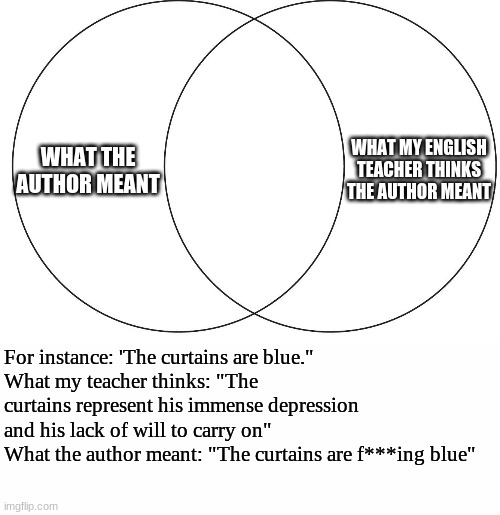
Spending a lot of my time online has resulted in my assumption that most of the internet is made up of teenagers trying to get back at their English teacher. One of the most annoying results of spending too much time online is seeing just how little media literacy or media criticism remains. The biggest problem stems from a belief that context does not matter. Thus, the image above, of an author claiming ‘The curtains are blue’, to the apparent dissatisfaction of the teacher, who tries to find a deeper meaning in it. While I imagine most of the children sharing this image, in whatever form it has taken that day, be it with an image of curtains or just text, do so because they are encountering media criticism that goes beyond surface level for the first time, there are plenty of signs that point to a decline in media literacy as a result of this sort of thinking.
Getting to the main reason for writing this post in such a red fury that I can hardly stop to give my fingers a rest, I should point out just how wrong the belief that the curtains were just blue is. The simplistic thinking that things in text just are because they are fails to misunderstand the subtext that can be gleamed from even the smallest detail. There’s a reason I used ‘red fury’ rather than just fury, and it’s not because red is commonly associated with anger, but because it is usually considered the opposite of blue. When a writer, artist or director includes details in a scene they do so with explicit purpose, even if they may not realise at the time. As my last post focused on a seminar examining the importance of context in one’s own writing, I thought it apt to approach this post in a similar manner by looking at the curtains example.
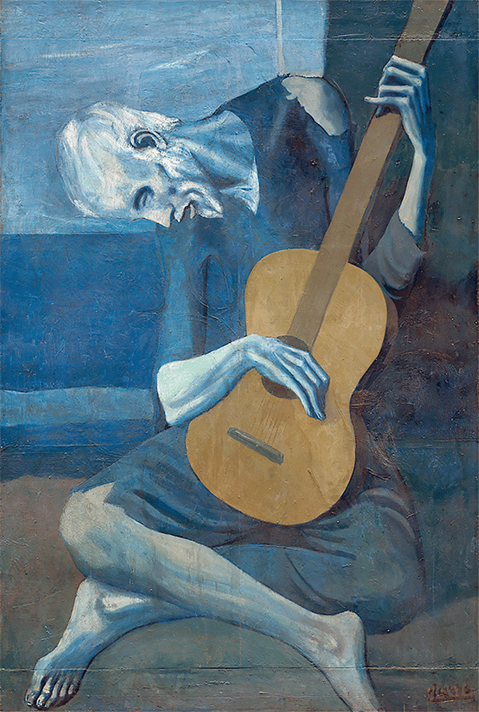
There’s always a reason for things to be described a certain way, even if the author isn’t always conscious of it. The blue curtains were designated as ‘blue’ for a reason, be it to convey melancholy as the image suggests, or just as likely, because the author is adding details to the world that go beyond the curtains. The owner of the curtains may like the ocean, for example, and think blue is the best colour to have in the house. With this thought we know more about the room’s owner through the curtains. If the colour of the curtains didn’t matter one iota, the colour would not have been mentioned. The context of when it was written or what the extract comes from are also important. If the blue curtains exists in the context of a sad, melancholic poem then considering the curtains to just be blue is a shortcoming of the critic. If the author was writing in a particular mindset and conjured up images relevant to their situation when writing, then the curtains being blue are just as important to the rest of the text.
This sort of thinking has unfortunately permeated a lot of pop culture discussions, as media literacy seems to take a back foot to uncritically liking or disliking works just because. There is nothing wrong, in theory, with liking something or not based on how it made you feel, or what it made you think when reading or watching it. I have found I enjoy films or shows I first watched as a child simply because I enjoyed them when younger. But I don’t express these opinions as fact, or as failings or successes of the works themselves, but rather just to show how I feel rather than why I feel the way I do. Surface level criticism and severe misunderstanding of works perhaps reached a new height with a particular YouTube channel that somehow has over 9 million subscribers, where an annoying ding will sound for whatever ‘sin’ a film has committed.
CinemaSins has cornered the market of satire or seriousness depending on crowd reaction better than any other ‘criticism’ channel on the platform. Any serious critique is presented as such until any criticism of the points raised turn it into a work of satire that shouldn’t itself be critiqued as true criticism. A series of videos by YouTuber Shaun go over everything wrong with the channel as a critic better than I ever could, but I felt it necessary to mention just how far I feel media literacy and criticism has been misunderstood by, presumably, teenagers and children who consume videos focusing on what should be considered “objectively wrong” with media. This post is already too long to consider my thoughts with ‘objective reviews’ of media, so that may end up another post by itself.