
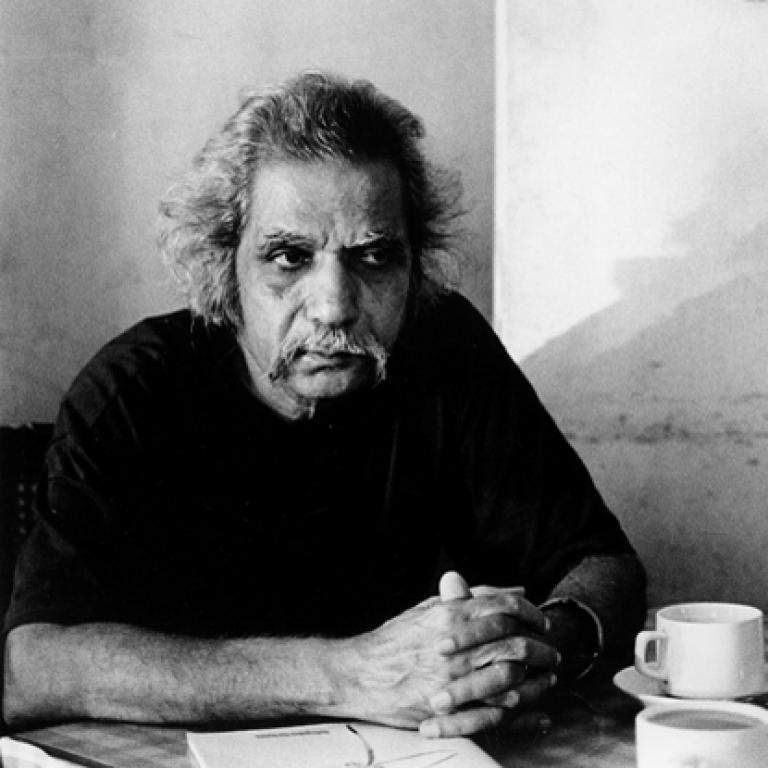
Kolatkar, in faded t-shirt, five-pocket jeans that he’d keep pulling up, and shod in a sturdy pair of unpolished shoes, retained about him the air of a tramp, albeit a stylish one.
Arvind Krishna Mehrotra
Being unfamiliar with Arun Kolatkar’s work, this research seminar caught my interest. Dr Narang introduced the works of Kolatkar by first introducing the man, providing some context to the points that were raised later. Indian independence and partition in 1947 occurred within Kolatkar’s lifetime so his poetry is able to reflect the post-colonial changes in India through irony and humour. One interesting point brought up was that authors establish a horizon within which a reader can interpret a text; that is that author’s cannot control how their work is viewed but can try and steer readers into their intended meaning. The interstitial nature of India at the time Kolatkar was writing seemed to be ripe for parody and caricature, often focusing on the mundane and playfully criticising authoritarianism.
My experience with Indian literature is non-existent, so being presented with a great example of Indian post-colonial humour and irony, I find myself comparing it to English colonial writing. In particular, I note that any appearances or reference to India are usually portrayed in a negative light. For example, many of the Sherlock Holmes stories focus on the negative outcomes that occur following a person’s experience abroad, particularly in India. Doyle’s work is rightly criticised for focusing on the savage nature of man that is brought out by foreign influence, so it was nice to see the perspective of post-colonial India from a poet who portrayed everyday life without malice towards the ordinary people. Kolatkar’s early work is more playful than his later work, which Dr Narang noted had a more austere style as well as being more aware of historical phenomena, as portrayed in Jejuri, his most well known work, where Kolatkar forces readers to interpret the work without cultural preconceptions. Overall, I enjoyed hearing about his work with post-colonial irony and humour, given much of my interest lies in Victorian literature which often incorporates elements of colonialism, as the British empire started to fall apart over the period.