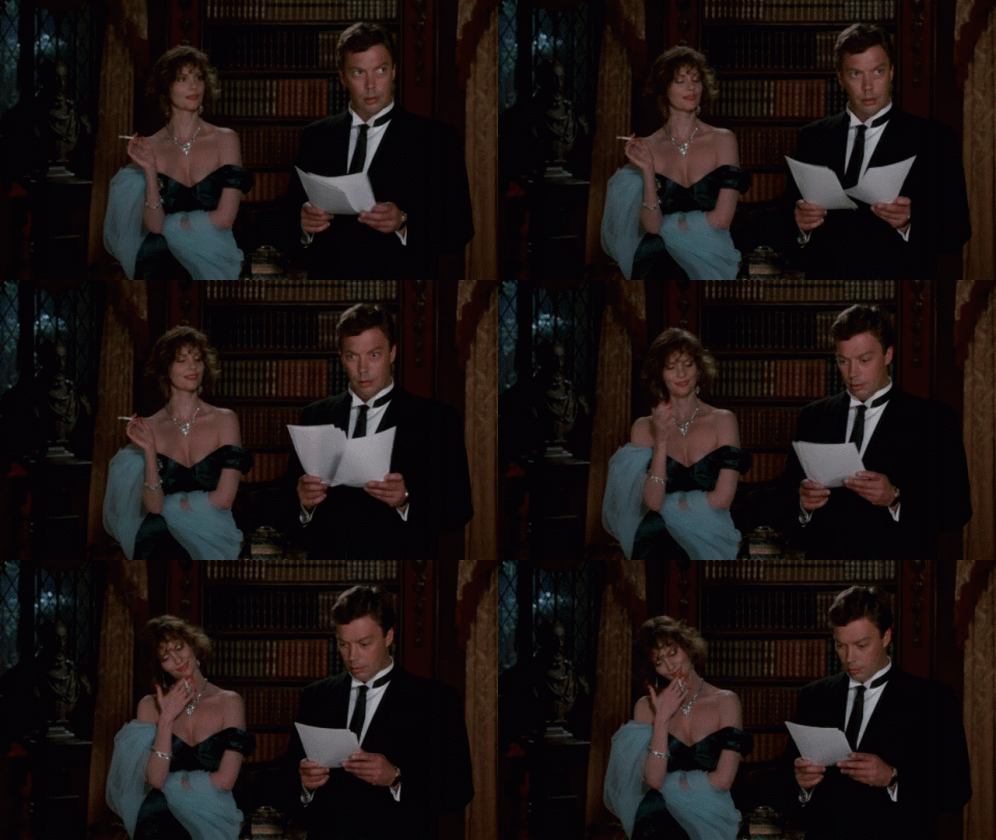
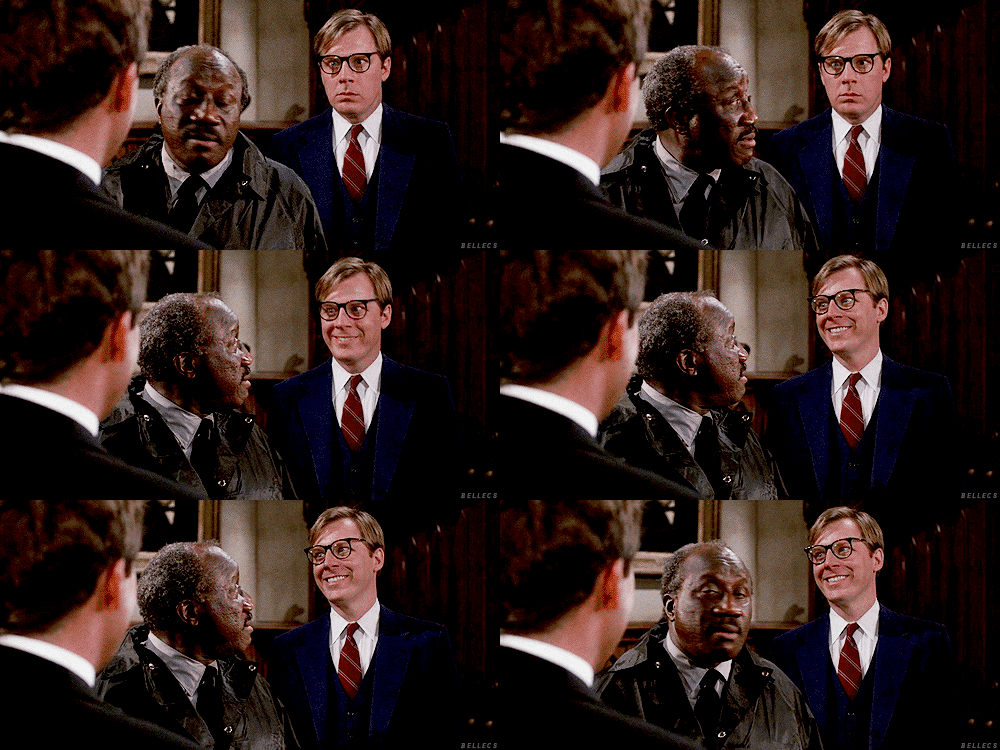
“Communism was just a red herring.”
Wadsworth – Clue (1985)
Our MA programmes were tasked with creating and maintaining a scholarly blog in early October, which would ultimately culminate with this post, a portfolio of sorts tracking the progress of my writing and my development as a scholar of sorts. Now, there is nothing stopping me from posting after this point, and in fact I will have to post a literature review that may be posted a bit before or a bit after this one, depending on how I progress with my thesis research. After our initial session on scholarly blogging, on October 11th this blog was started with no clear direction or goal. The title of the blog itself, “Convergence”, was a bit of a clever in-joke for just myself given how I styled the site after The Verge’s most recent design change, especially in regards to the colour (though I do my best to incorporate green in some shade into almost every part of my life). Having no idea or direction for my eventual MA thesis, I figured I would just start with A Start rather than introduce my ideas at the time, which were few and far between. And yet already the seeds for my eventual research topics were present from the very beginning.

“Given my interest in Victorian detective fiction, it wouldn’t be surprising to see a post about an adaptation of a Holmes story, or even more recent mystery narratives. I have written essays in the past on links between game narratives and the texts we studied throughout a module, an idea I could see myself return to here. Rather than write a 3,500 word essay on the links between Daniel Defoe’s ‘A Journal of the Plague Year‘ and ‘The Forgotten City’ (2021), a murder-mystery set in a Roman city with peculiar ideas on law and order, I could write a short blog post that I could then expand upon at any time, either within or without this blog. No matter what I decide to do, it will inevitably involve different ideas coming together to form new ideas and conclusions. It will all be about convergence.”
https://convergence.hcommons-staging.org/2022/10/11/a-start/
I figure for the purposes of a portfolio portraying my potential progress as a scholar I should look at most if not all of the blog posts, as they can possibly showcase similarities or changes in my thinking or writing style. Of the post I have written thus far, five of the fifteen are about the various research seminars I attended throughout my year as an MA student, being required to write about at least two. I did attend a few I ended up not writing about, for whatever reason, but the ones I did pen posts for let me fulfil my self-imposed quota of two posts a month minimum. I often struggle to sit down and actually write out my words (though type out is more accurate, given how little I write on paper at all these days) as a result, I think, of the distractions inherent in a machine with access to the internet and video games. I have tried and failed to write using my iPad more frequently than my desktop, maybe due to my familiarity with the keyboard allowing a faster flow of text than any of the keyboards I can use with the iPad. This struggle with my own writing is I think reflected in the first post on a research seminar, about Rita Kelly and her revisiting of her own work decades later.
“Revisiting one’s own work can have a profound impact on our future work, or in this particular case, one’s postgraduate degree. Knowledge of one’s own shortcomings or successes in writing should be of great concern for any writer, academic or creative. Noting the influences on your own writing, as Kelly covered in her research seminar, is very important when contextualising past work and for future writing. Writing is always in the moment, as we carry our experiences and the world around us into the text. Separating the context from the text is an inherent failure in understanding any artistic undertaking. It is a great disservice to criticism, academic or otherwise, to fail to consider this. Kelly’s poems were interspersed with Irish language, as a result of her environment at the time she was writing, for example. In fact, my issues with broader criticism, or media literacy as a whole, are too broad to be tacked on here and deserves a post of its own.”
https://convergence.hcommons-staging.org/2022/10/18/reflecting-on-recognised-writing/
Within this post I already started a trend, I think, of mentioning future posts that I could write that would allow me to go into further details with whatever I had in mind, setting an expectation for myself to return to my thoughts on a particular subject later on. I usually write in chunks of a few hours every week, usually when I set myself a deadline for the blog or when writing for essays or the like. I am not the type of person to write for five minutes a day and leave my work, finding it much better to focus completely on one task for as long as possible, knowing I may not return to the topic with the same interest as I previously had. This portfolio is one such example, with the lateness of the hour not as pressing as my need to finish this in one sitting lest I be distracted and approach it with a different direction at a later stage. My next post was published a week after the Rita Kelly post but was in fact written in the same sitting. The WordPress platform allows for scheduling posts, which I used less frequently than I would have liked but allowed me to work in blocks of writing rather than needing to return to my desk to write every two weeks. My The Curtains are Blue post was written without much thought as I followed on from the little idea planted in the Rita Kelly post, so it didn’t even get the cursory glance over I would give my other work. Re-reading it again, I can see where I would have expanded on certain ideas, like the failings of the youtube channel CinemaSins, by mentioning anecdotal evidence of the impact it has on media criticism. As someone who watched the channel’s videos during my teenage years, I remember being in the room when someone mentioned watching the newest video to see ‘why the film was bad’, essentially, placing as much of an arbitrary reasoning for disliking a film as the channel does on finding “flaws”. I can sense in the post some ideas I would further expand upon in my research, specifically noting the reasons why details are mentioned and in what context. If I were to write a follow-up to Blue Curtains, I would probably title it Red Herrings. Again, I end the post with a potential promise of a follow-up, though this one never materialised.
“If the colour of the curtains didn’t matter one iota, the colour would not have been mentioned.”
https://convergence.hcommons-staging.org/2022/10/25/the-curtains-are-blue/
Rather than go into the potential post regarding “objective” reviews, I instead turned my attention to video. In a similar way to tv and film adaptations, music videos are an interesting act of adaptation as visuals are set to text and music. Rammstein’s video library stretches decades and is filled with some really great interpretations of the original music. It is a curious exercise, to create a video for a mass audience while singing in a language only some of them can understand.
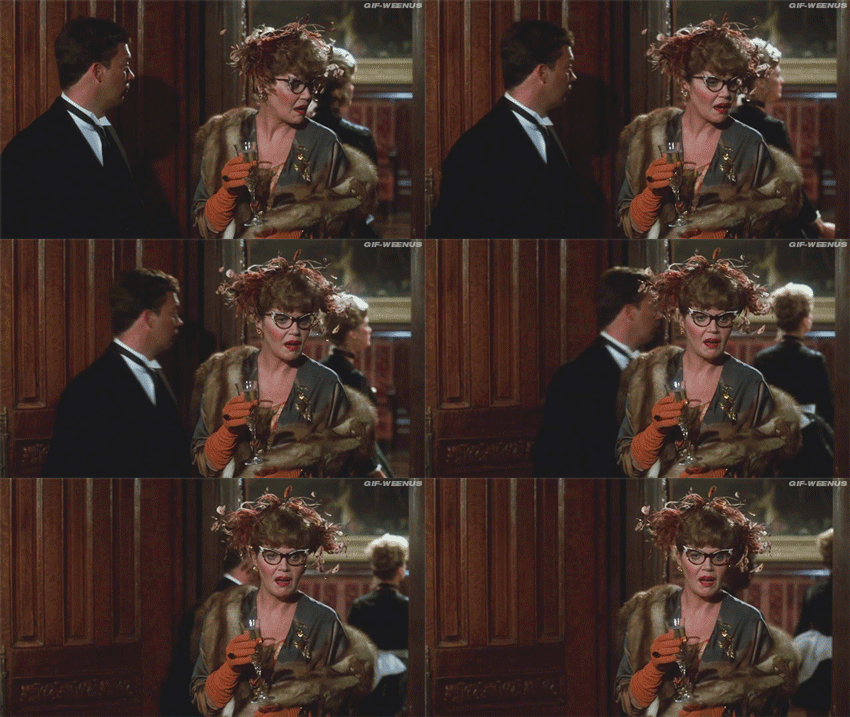
“What the music video does so well is that it focuses in on the fearmongering of the unknown, highlighting a typical (presumably American) group of suburban neighbours who grow increasingly scared and paranoid of one another as ghastly cheerleaders dance to the music. The focus is on Lindemann’s character, as a talking head spreading this fear and paranoia throughout broadcasts and on the TVs, prompting the everyone to build walls and stock up on guns before everyone is consumed by their fear.”
https://convergence.hcommons-staging.org/2022/11/01/poetry-in-motion-rammsteins-visual-lyricism/
While some of the early posts follow on from the general theme of “convergence” I set out when naming the blog, the next post was less of a convergence of ideas and more creating a connection to my interests in order to write about a research seminar. Victorian literature and themes of colonisation are a common topic of criticism, so it is no surprise that I focused on the “decolonisation” aspect of the research seminar, examining the impact of the police force on Victorian audiences and their interest in detective fiction. I even attempt to justify my writing about this, having had the idea following the research seminar and finding I did not have much to write about the topic discussed.
“I have found there is always something interesting to learn from talks and seminars, even if they only indirectly impact my own areas of interest. This goes from getting a deeper appreciation for the background to a writer’s work to examining what parts of history we celebrate and which we should work to diminish the importance of in an effort to decolonise our way of thinking.”
https://convergence.hcommons-staging.org/2022/11/08/commemoration-and-criminals/
The next post, also on a research seminar, again evolved into a look at Sherlock Holmes rather than the topic at hand. The seeds of my research interest were starting to grow into a vested interest in detective fiction, though the direction it would take was still unknown to me at the time.
“My experience with Indian literature is non-existent, so being presented with a great example of Indian post-colonial humour and irony, I find myself comparing it to English colonial writing. In particular, I note that any appearances or reference to India are usually portrayed in a negative light. For example, many of the Sherlock Holmes stories focus on the negative outcomes that occur following a person’s experience abroad, particularly in India.”
https://convergence.hcommons-staging.org/2022/12/01/the-post-colonial-humour-of-arun-kolatkar/
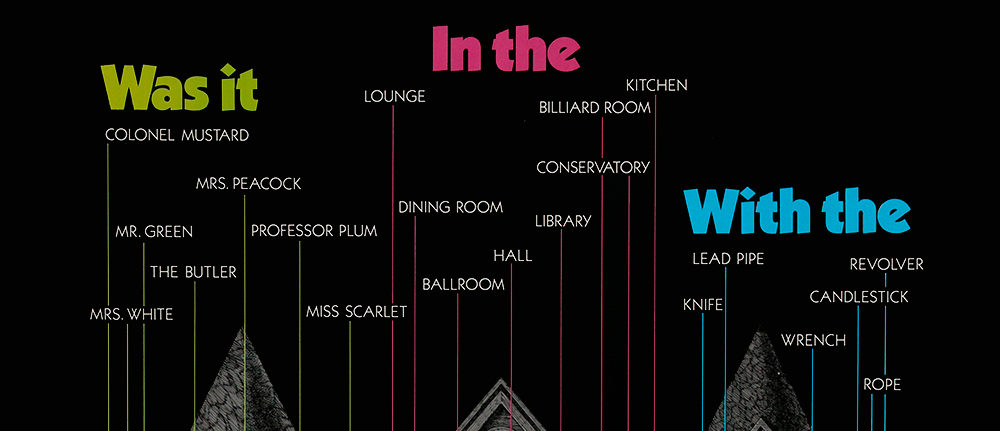
My next post summarised some thoughts on the research seminar, so rather than re-examine that one I think the Modern Mysteries of Murder post serves to further the narrative I am trying to build better. I had this idea to write about the recent resurgence of murder mystery films after seeing Glass Onion in the local cinema during its one week run before its eventual release on Netflix. See How They Run turned out to be an admirable film to focus on, and my writing I feel examines how the audience is introduced and interacts with the events playing out on screen. See How They Run even ends up talking to the audience through the play of The Mousetrap that is integral to the story. I again bring up Holmes as a character, given the obvious template Doyle set for future detectives, himself working off of Poe’s work with Dupin. I also note how I use the same video as reference to how one adaptation in particular makes mistakes on focusing too much on Holmes as I do in my mini-conference reflection. I think I have probably watched it a few times in the time between the two posts too. If I were to re-write this particular post, I would probably include more information regarding audience participation or interaction, and maybe even bring in the classic 1985 film Clue with its multiple endings, as well as examining how an adaptation of an interactive medium (in this case a board game) works in the form of a film. I keep mentioning my unfulfilled ideas for future posts, but Clue could make an interesting topic for one…
“Benoit Blanc as a character is also a much bigger focus than he was in the first film, where he could even appear as an antagonist to Marta, the film’s primary character. But like any good writer of detective-based mystery, Johnson does not focus solely on the character but rather the mystery being presented. This falls in line with how Conan Doyle would characterise Holmes, via Watson, through the mystery rather than have the mystery occur around Holmes, a mistake at least one Television adaptation made, and which I feel would lessen the impact of the mystery in the narrative. The detectives found in the stories can be presented as part of the mystery, perhaps being involved with a suspect or the victim, but shouldn’t be the reason why there is a mystery to begin with. This isn’t to say there should be no character development between chapters, books, episodes, or films, but the detective in the stories should usually remain the one constant, especially when there is often a brand-new cast of characters in each story. Blanc is introduced in the first film in much the same way Holmes would be, as an outsider to the story trying to solve the puzzle and look for clues, while in the sequel we are introduced to Blanc before the mystery begins, bored out of his mind thanks to the pandemic forcing him to stay at home. And while I could go on, I feel I have written enough on the subject for the moment, lest I run out of material for future posts, and if this blog should be the basis for any future ideas, I hope I can look back on posts like these to try and find ideas to use.”
https://convergence.hcommons-staging.org/2022/12/03/modern-mysteries-of-murder/
At this stage of my research, I had done no research. I had this vague notion of detective fiction that I wanted to focus on but was doing no real outside reading, instead focusing on watching or reading whatever mystery seemed up my alley. It was also around this time that I started a re-watch of all Scooby-Doo tv shows and films. I credit the need to research more for the thesis with my current hiatus on that “project”, although I will probably refer to any episode with Sherlock Holmes if given the chance. While the post on the Dun Emer Press makes a note of the publication method of the Holmes stories, I don’t return to the idea around detective fiction until the end of my post on the Lego video games.
Adaptation theory has been a running idea throughout my blog posts, as I make semi-frequent references to adaptations of one form or another in every other post. This post marks the first time I focus solely on adaptations, and notably it is in the form of video games. While I make no mention of player interaction with the story, I think if I would have continued with the idea of writing about a game adaptation having had no other ideas for the monthly blog posts, I would have brought in the unique interactive element that video games offer as a form of adaptation especially.
“There is no real secret sauce to the success of the 20+ games released over the past 18 years, and some in fact have had a poorer reception than others, but there is little criticism to be had over their approach to adaptation. Perhaps because the games are marketed towards children, and many who played the games in their childhood will look back fondly on the imperfect games, or maybe because there is a general understanding of the limitations that are put on the games, that there is very little criticism of the problems that arise with other adaptations. Technical limitations are often enough for fans to forgive any differences with the source material, with the first few games (Star Wars, Indiana Jones, Batman etc.) up to 2012’s Lego Batman 2: DC Super Heroes having no voice acting at all, relying on mumbles and quite a few jokes to hit the story beats that were being adapted. That same year, Lego Lord of the Rings released to positive reception, based not on the book but on the Peter Jackson trilogy. This was not the first Lego game adaptation of an adaptation of another work, but was the first to use the audio from the adaptation it was based on rather than the mumbles or original voice acting found in the previous games.”
https://convergence.hcommons-staging.org/2023/01/31/adapting-brick-by-brick/
Having a firmer idea in mind for my research topic going into February, the Wikipedia editing session allowed me to look at adaptations of The Hound of the Baskerville in a different light, editing in more citations regarding the novel’s relation to the video game series Ace Attorney. This act seemed to solidify my interest in the topic of Sherlock Holmes, though what particular angle to approach it with still eluded me. The post afterwards returns to the world of adaptations, with only brief mention of Sherlock Holmes, so it is not entirely relevant to the ideas this portfolio is trying to present, of an underlying theme gradually appearing as my research interest hones into view.
“There is plenty to be said about the usage of the character of Sherlock Holmes in contemporary fiction, decades after the final “official” story that Conan Doyle wrote. In my research on the Sherlock Holmes character I have encountered numerous stories and novels that utilize the character. While pastiches and parodies of the character have existed since Doyle’s own time, sincere stories told with the character have sprung up since the characters entered the public domain”
https://convergence.hcommons-staging.org/2023/03/27/neo-holmesian-fiction/
Before ultimately settling on the idea of ‘the game’ with relation to the detective narrative, I looked at new Holmes stories and the parodies of the character as another avenue to research. I will admit one of the reasons for this is my affection to the humour of people like Wodehouse and my desire for more people to be familiar with these works.
My final post prior to this one (lit review notwithstanding, depending on its publication date) is about the mini-conference held on the 6th April. This, I feel, is a culmination of the ideas, the ultimate convergence event, so to speak, for everyone presenting on the day. My focus on the character of the hound was supposed to be situated in relation to the audience’s reaction and interaction to the mystery unfolding. I feel I could have done a better job at this, which my post reflects.
“The ‘game’ such as it is was not really mentioned in my presentation, although at the moment it is the primary focus of my research. The narrative structure of mystery stories like the Sherlock Holmes canon allows the reader to, in a way, interact with the story, guessing the villain and looking for clues present in the text to discover the truth before even the detective does. I briefly mentioned the video game adaptation of Hound, of which I have played little, and I could have gone more in depth with how the format of a hidden object game puts the player in a heightened position compared to the reader of the source material, directly involved in the investigation rather than looking on from the outside.”
https://convergence.hcommons-staging.org/2023/04/09/reflections-on-textualities-mini-conference-2023/
Reflecting on my own writing is something I struggle with, as one of my very first posts makes clear. This blog has offered me an opportunity to introspect a bit on my writing and research. Writing up this portfolio made me realise just how obvious my ultimate research topic could be to anyone who read the words I uploaded, the works I chose to focus on and my reasoning for writing what I did. While it may not be a surprise to any potential reader, it was a bit of a surprise to me. I have to say I am a bit disappointed to see this somewhat constant in my life coming to an end in a manner like this. 3000(ish) words doesn’t seem enough to write about almost six months of my life as an academic. I still have issues to work out with my writing (I note I never really reference anything, usually linking out to other sites when needed), and I think I need to look back on my work much sooner than I do now (this being the first time I’m re-reading my own words in some cases) to better myself as a writer and academic. So with that in mind, I think I will continue to post on this blog, a promise I seem to make often at the end of these posts, hoping (perhaps in vain) that I can convince my brain to return to this site more often than I need to as part of the coursework. Maybe I can write about particularly interesting articles that relate to my thesis research, or review any future mystery films and shows as they come out. But I have learnt over the course of my blogging that these end of post ideas don’t usually bear fruit, so for the moment I am not making any promises and instead leaving with a tentative note to my future self to not turn the page, but rather continue as I am.